
Runner's Knee: A Clear Path Back to Running in San Antonio
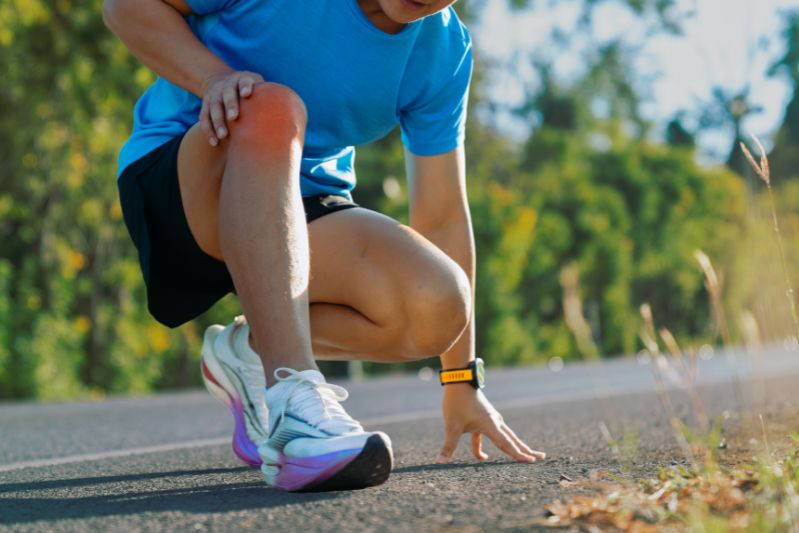
San Antonio built itself a runner’s city without making much noise about it. The Mission Reach along the river carries a steady stream of morning miles, the Howard W. Peak Greenway system links creek trails across the whole metro, and Salado Creek, Leon Creek, McAllister Park, and Phil Hardberger Park all stay busy from before dawn until well after dark.
Add a race calendar that runs from fall through spring and there is no real off season here.
Which is exactly why so many local runners spend part of the year negotiating with one knee.
Runner’s knee is the most common injury that walks into our offices from that crowd. What makes it frustrating is not the pain level, which is usually moderate. It is the uncertainty. Most runners have no idea whether they should rest, push through, see someone, or start over from zero. This article is about answering that.
What Is Happening at the Knee
Runner’s knee is the common name for patellofemoral pain syndrome. The kneecap sits in a groove at the end of your thigh bone and glides through it every time the knee bends and straightens. Running asks it to do that roughly 1,500 times per mile while managing forces several times your body weight. When the tracking shifts slightly or the total load outpaces what the joint has been prepared for, the tissue around the joint becomes irritated and sensitive.
It is by far the most common single diagnosis in running. A systematic review of running related injuries put knee injuries at a 31.2 percent prevalence, higher than any other region, with patellofemoral pain accounting for 16.7 percent on its own. That review also found roughly 44 percent of runners were dealing with an injury at any given time.
Importantly, this is an irritation and overload problem, not a structural failure. That is good news, because overload problems respond very well to being managed properly.
Signs It Is Runner’s Knee
- An ache around, behind, or beneath the kneecap rather than a specific sharp point
- Pain that builds through a run instead of appearing suddenly
- Worse going down stairs or down hills than going up
- Stiffness or ache after sitting for a long stretch with the knee bent
- Mild grinding or clicking when the knee bends
- Little or no swelling
Pain that came from a single twist or impact, a knee that locks or gives way, or a joint that swells noticeably within a day points somewhere else and should be evaluated promptly.
The Two Things That Actually Cause It
Nearly every case we see comes down to some mix of these.
The load went up faster than tolerance. This is the bigger of the two and the easier to miss. Runners tend to count miles and ignore everything else, but tolerance is built by total stress: distance, pace, hills, surface, shoe wear, sleep, and heat. A San Antonio runner who adds a long run, starts a speed workout series, and moves training to August afternoons has changed four variables at once. The knee is not weak. It just got handed a bill it was not expecting.
Control broke down upstream and downstream. The kneecap follows the thigh bone, and the thigh bone follows the hip. When the gluteal muscles on the side of the hip cannot hold the pelvis level and the thigh stacked over the foot during single leg stance, the knee drifts inward on landing and the kneecap loads unevenly. At the other end, a foot that collapses hard or an ankle that cannot bend far enough sends the same rotation up from below.
The research is consistent on this. A meta analysis in the Journal of Orthopaedic and Sports Physical Therapy found that hip and knee strengthening together beat knee strengthening alone for reducing pain and restoring function. A separate systematic review of manual therapy for patellofemoral pain found better outcomes when care addressed the full kinetic chain, including the lumbosacral and sacroiliac joints, rather than the knee by itself.
How We Approach It at South Texas Spine and Knee
Dr. Josh Bonine and our team treat runner’s knee in stages rather than as a single fix, because the goal is not just a quiet knee. It is a knee that stays quiet when the mileage comes back.
Stage one: find the real driver. The exam covers hip strength and single leg control, kneecap tracking and mobility, ankle range of motion, foot mechanics, and how the low back and pelvis are moving. We pair that with your actual training history: weekly mileage, what changed in the last month, your shoes and their mileage, your usual routes, and which part of the run hurts first. That conversation often identifies the cause before any test does.
Stage two: calm the joint down. Joint work at the knee, hip, ankle, and lower back restores motion and reduces the compensation loading the kneecap. Soft tissue therapy through the quadriceps, IT band attachments, hip rotators, and calf reduces the pull working against clean tracking. This stage usually moves quickly and is where most people feel the first real change.
Stage three: rebuild capacity. Hip abductor and external rotator strengthening, controlled single leg loading, and graded quadriceps work give the joint the tolerance it was missing. This is the unglamorous part, and it is the difference between a six week resolution and a problem that returns every training block.
Stage four: return to running on a plan. We do not send people back out with “see how it feels.” Mileage returns in measured steps, with clear rules for what pain is acceptable during and after a run. Where gait is a factor, small adjustments help: an umbrella review of gait retraining found that increasing step rate by 5 to 10 percent reduces knee loading and produced short term improvements in pain and function when introduced gradually.
Because we also see plenty of hip, ankle, and low back complaints from the same runners, we look at how the whole system is moving. A runner compensating for a stiff ankle often loads the opposite knee harder without ever noticing.
What Recovery Usually Looks Like
Most runners want a timeline, so here is an honest one.
Caught early, within the first two to three weeks of symptoms, runner’s knee commonly settles within four to eight weeks, with modified running continuing through most of that window. Cases that have been ignored for several months take longer, often three months or more, because strength and control have to be rebuilt rather than simply restored.
Through most of that, running does not stop. It changes. The usual guideline is to keep running at a level where pain stays at a two or three out of ten during the run and is no worse the next morning. In practice that means shorter distances, flatter routes, a pause on speed work and long downhills, and more frequent easy days. As capacity improves, distance comes back first, then hills, then speed.
What to Do in the First Week
If the ache is new, you do not have to wait for an appointment to start helping it. Cut your next three runs to a distance that stays comfortable and keep them flat. Drop speed work and long downhills entirely for now. Add two short sessions of hip work, side lying leg raises and glute bridges, on non consecutive days. Check your shoe mileage. And write down what changed in your training over the four weeks before the pain started, because that note is often the most useful thing you can bring to your first visit.
Keeping It From Coming Back
Strength trains your hips twice a week, in season and out. Increase weekly mileage gradually rather than in jumps, and change only one training variable at a time. Track shoe mileage and replace shoes on schedule rather than on feel. Rotate your routes so you are not always running the same surface, camber, or hill. Respect the heat, which changes your form more than it changes your pace. And treat a new ache in week one, not week six.
Ready to Get Back to Full Mileage?
You do not have to guess your way through this or shelve a season you have been training for. Our team works with runners across the region every week, and most people start seeing real change within the first few visits.
Call 210-233-8800 or book your evaluation online. We have locations in Northwest San Antonio, the Southside, Selma and Schertz, and Kerrville and the Hill Country, with same week appointments available. Tell us what you are training for, and we will build the plan that gets you back to it.
Frequently Asked Questions
How do I know if it is runner’s knee or something more serious? Runner’s knee produces a diffuse ache around or behind the kneecap that builds during activity, with little or no swelling. A specific traumatic moment, locking, a knee that buckles, or noticeable swelling within a day suggests a meniscus, ligament, or cartilage issue instead and should be evaluated promptly rather than managed as an overuse problem.
How soon can I get back to full mileage? Most runners who start care within the first few weeks are back to their previous mileage in roughly six to ten weeks, with modified running continuing throughout. Longstanding cases take longer because strength and movement control have to be rebuilt. The return happens in stages: distance first, then hills, then speed.
Should I stop running completely? Rarely. Complete rest lets the pain settle but does nothing for the strength and mechanics that caused it, so symptoms usually return with the first real week of training. Reducing distance, avoiding downhills and speed work temporarily, and adding strength work generally produces a better outcome than stopping.
Why does my knee hurt going down stairs but not going up? Descending loads the kneecap harder. The quadriceps have to control your body weight, lowering under gravity while the knee is bent, which presses the kneecap into its groove at the exact angles where an irritated joint is most sensitive. It is one of the most recognizable signs of patellofemoral pain.
Do I need new shoes or custom orthotics for runner’s knee? Shoes matter mostly when they are worn out, typically somewhere between 300 and 500 miles. Orthotics can help selected runners whose foot mechanics are clearly contributing, but they are one piece of a plan rather than a solution by themselves. We assess this during the exam rather than recommending it by default.
Does chiropractic care help knee pain, or only back pain? Chiropractors are trained to evaluate and treat the joints and soft tissues of the whole body, including the knee, hip, ankle, and foot. Extremity and sports care is a routine part of practice, and the research on patellofemoral pain specifically supports addressing the hip, pelvis, and low back alongside the knee.

Main office Location
Location Address:
2211 NW Military Hwy #116, San Antonio, TX 78213
Southside / SouthPark Mall
Location Address:
94 Briggs, Suite 300, San Antonio TX 78224
Selma / Schertz
Location Address:
17170 Jordan Rd, Suite 405, Selma TX 78154
Kerrville / Hill Country
Location Address:
124 Blueridge West, Suite 206, Kerrville, TX 78028